
December 19, 2019
The problems generated by the dramatic consequences of climate change and excessive usage of natural resources cannot be faced by world communities without engaging in new and more sustainable ways of producing goods and services. An impact on the environment is present throughout the lifecycle of those products and services from the extraction of raw materials to their use and eventually disposal, but procurement decisions and policies that company take can help significantly reduce those impact locally and globally.
All major corporations have defined and implemented policies for a sustainable procurement covering economic, environmental and social factors of the supply chain, but still, vast issues are present in several supply chains.
A new emerging technology is normally associated with the improvement of sustainable supply chains for its potential of improving traceability and accountability and this is the “Blockchain”.
I have collected here some ideas and thoughts that come from my readings and copy-pasting of notes and numerous articles on this topic, trying to understand if blockchain will be the silver bullet to make some of the most critical supply chains in the world sustainable and ethical and some of the findings have surprised me.
BLOCKCHAIN, WHAT IS IT?
“The blockchain is an incorruptible digital ledger of economic transactions that can be programmed to record not just financial transactions but virtually everything of value.” – Don & Alex Tapscott, authors Blockchain Revolution (2016)
A blockchain is a time-stamped collection of permanent data records, maintained by a network of computers not operated by any single entity, in the simplest of terms. Each of these data blocks (i.e. block) are secured using cryptographic principles (i.e. chain) and connected. Network members will validate transactions independently of a third-party entity using blockchain technology, producing a "virtual ledger" of transactions. A shared digital asset database that can not be compromised and is considered a "trust network".
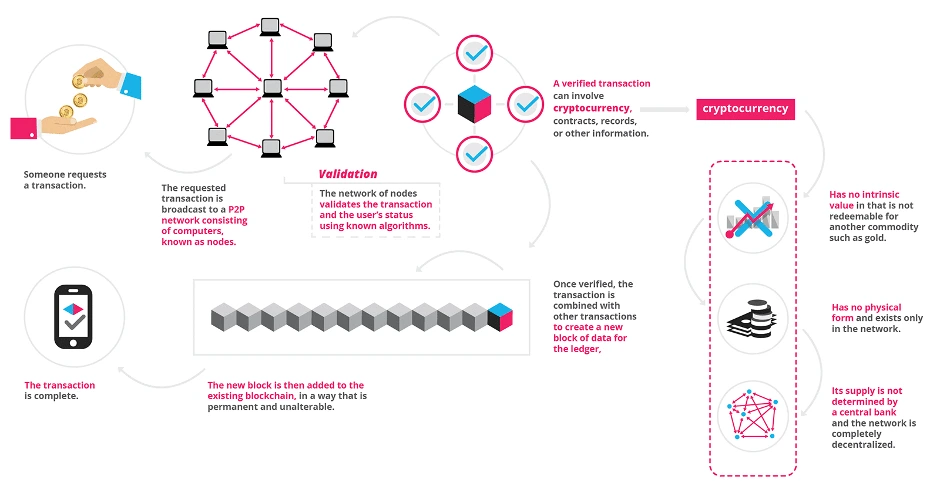
(Image source: blockgeeks.com)
Traditional IT processes cannot provide complete transparency on the end to end supply chain, and cannot provide the guarantee that market actors and consumers nowadays demand about the origin of products. Logistics and transportation processes are still mostly managed in non-automated and not interconnected ways (email, phone, etc.) and are still often reliant of paper documents. Data are archived in different and distinct repositories for all the actors of the supply chain. The consequence is that information is fragmented and often incomplete or contradictory. This scenario will radically change with the widespread adoption of the blockchain technology that will associate to each physical object a digital identity that will assure
BLOCKCHAIN ADVANTAGES
Blockchain transactions are characterised by:
• Public availability: blockchain is shared and updated in real-time to all parties
• Security and privacy: Cryptography prevents unauthorised access to the information each party access only the info they are authorised for
• Transparency: participants to a transaction can see the same records and can validate transactions and verify identities without third-party intermediaries
• Traceability: complete transaction and asset history can be backwards traced preventing fraud and counterfeit goods
• unchangeability: nobody can modify a transaction after it has been recorded.
And can deliver multiple advantages in the supply chain execution:
Smart Contracts
A typical contract is a two-party or more arrangement that will tie them to something in the future. In return for using Bob's house (aka rent), Alice may pay Bob some money. Charlie can decide in the future to repair any damage to Denise's car in exchange for a monthly payment (aka car insurance).
What's special about a "smart" contract is that computer code tests and executes the conditions, making it trustless. So, some software will decide if the conditions are valid and do the execution without giving either party the ability to back out.
A smart contract's key feature is that it has trustless execution. That is, to implement different conditions, you don't need to rely on a third party. Instead of relying on the other party to make good on their word or worse, relying on attorneys and the legal system to fix issues should something go wrong, a smart contract implements promptly and objectively what is supposed to happen.
A smart contract is a set of executable code that runs on top of the blockchain to execute the contract, i.e. a software program. Without the need of a trusted third party, smart contracts will automatically find, negotiate and close deals across a supply chain.
The smart contract will operate exactly as planned, with terms and conditions that can be defined by both parties, ensuring trust in the contract's enforceability and counterparty identity. The smart contract will automatically deliver a result or trigger an event when certain conditions are met. For example, a delivery can be triggered automatically if a payment has been received. On the flip side of the coin, a penalty may be induced if a condition has not been met such as timely delivery.
Because smart contracts are founded on a computer program that runs automatically — using data guaranteed by the blockchain to be valid — manual verification of conditions and events by third parties can be avoided, transaction costs significantly reduced and profitable trades facilitated.
Improved Purchase Order Management.
Order Validation and authorization, invoice processing, multi-way matching, and the whole request-to-receipt process could be dramatically improved by applying blockchain to procurement. Any adjustment in any part of the process will automatically create an exception that will reduce the total processing time and allow much greater transaction automation.
Visibility and traceability of the supply chain.
Blockchain technology in the supply chain will provide the buyer with the means throughout the buying process to ensure quality and traceability of all products. Verifiable audit trails will be created for the products of the suppliers. Key qualifications, licenses and qualification status of the manufacturer will remain free from forgery and other compromises.
Real-time or accelerated payment.
Smart blockchain-based contracts and orders on completion of the transaction process may automatically trigger pre-agreed transactions.
Accelerated handling of the purchase order.
Compared to current performance levels, purchase order and goods receipt information would be shared on the blockchain at an accelerated pace. The blockchain could also help identify the network's closest and most cost-effective supplier. This would help to reduce the lead time and workload associated with supplier searches, purchase order management, and receipts for goods / services.
Reshaped handling of invoices.
Thanks to shared access to the database, invoice scanning would no longer be required with the sharing of invoices facilitated by the blockchain. This would also make the process of reconciliation much less difficult as all approved parties will audit the same transaction, removing the need for reconciliation. For general accounting and financial reporting purposes, blockchain powered transactions will feed into the general ledger of the company.
Managing inquiries simplified.
Blockchain's increased transparency would eliminate the need for enquiries and follow-up system status, thus streamlining current processes of enquiry management and control.
Reduced risk of money laundering.
Through keeping past payment information permanently, it is easier to identify suspicious transactions.
Greater stakeholder trust.
Blockchain technology will help to increase trust between clients and suppliers through shared public IDs, simple and fair referral mechanisms and ratings / scores awarded to all market players based on product quality consistency in delivery and timely invoice payment. The history of transactions collected and stored would also help build trust and accountability.
Strong audit trail.
The transactions are stored as all parties are registered in the ledger and a non modifiable audit trail is maintained. Such form of end-to-end transparency in procurement is a well-established practice of physical goods tracking
Increased payment protection.
This can be accomplished via a cloud-based contract database and an integrated e-sign function that verifies the identity and authorization of the signer.
SUSTAINABLE SUPPLY CHAINS AND BLOCKCHAINS
There several ongoing projects examples of blockchain applications to make supply chains more sustainable, here some examples:
The Seam has created a platform for the world cotton industry to record the exchange of cotton in real-time in the supply chain
The Italian Government is working on a project to protect “made in Italy” products and avoid counterfeits and labour exploitation
Some the best applications for blockchain to protect marine supply chain have been started in Indonesia for wild-caught, fresh/frozen tuna and in Thailand for farmed shrimp
Diamond giant De Beers has announced that they will use blockchain technology to track stones from the moment they are mined to the point of being sold to consumers. The project aims to ensure that the business avoids diamonds with' blood' or' conflict' and ensures that customers buy the genuine product.
But probably one of the most widely impacting supply chain for its environmental and ethical issues is the palm oil industry
THE PALM OIL SUPPLY CHAIN EXAMPLE
In terms of volume produced next to soybean oil, palm oil is the largest vegetable oil in the world. Approximately 50% of common consumer products contain palm oil and palm oil-based ingredients. Palm oil is used in many food products but is also used in household detergents, conditioning agents in shampoos, creams, soap, lipsticks and biofuels for vehicles and power plants.
Palm oil production has become a common way to meet global vegetable oil demand as palm oil is considered the highest yielding vegetable oil crop as it needs less land area and less fertilizer and pesticide inputs.
Worldwide palm oil production has been steadily rising for five decades. Annual production quadrupled between 1995 and 2015, from 15.2 m tons to 62.6 m tons. It is expected to quadruple again by 2050, hitting 240 m tons. The EU is one of the largest importers of palm oil, 85 per cent of which come from Malaysia and Indonesia, where the worldwide demand for palm oil has increased incomes, but the rapid expansion of palm oil plantations has often led to substantial deforestation, with labour and human rights abuses involved.
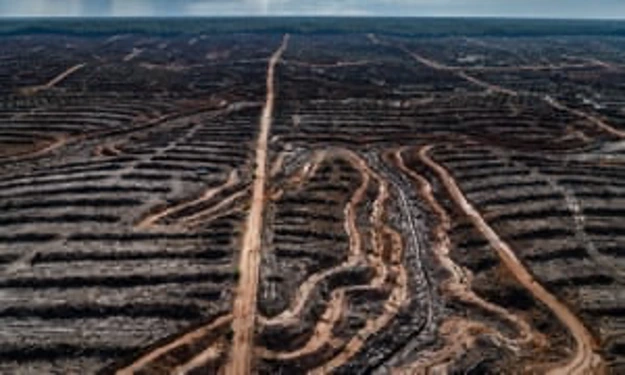
A deforested palm oil concession in Papua, Indonesia Photo: Ulet Ifansasti/Greenpeace
Sustainability is critical as oil palms grow in areas that are environmentally vulnerable. The Roundtable on Sustainable Palm Oil (RSPO) has partnered with the global supply chain since 2004 to change the palm oil industry and promote a transition to 100% sustainable palm oil. Palm oil producers, processors and manufacturers of end products are wrestling with how to solve problems while encouraging sustainability. There is still no clear-cut way to trace palm oil back to its original plantation due to a fairly opaque supply chain. Despite efforts, only 17% of the global production of palm oil is rated as sustainable.
Nonetheless, a growing number of actors in the palm oil industry agree that blockchain can be used to close current supply chain gaps and foster accountability and fulfil the NDPE (No Deforestation, No Peat, No Exploitation) policy objectives.
Blockchain could be used to monitor the entire process from the geolocation of harvested bunches of fruit to the identities of palm oil workers and harvesting times, thus helping to reduce the spoilage of palm oil. Palm oil is prone to poor reaction if it is incorrectly stored making the product harmful for consumption.
Once they hit the market, blockchain could be paired with sensors to track shipping and transport conditions to detect bad batches of palm oil.
Palm oil is traded as futures contracts or physical batches and paper property titles in multiple markets, and a shipment of Asian palm oil can switch owners several times before it reaches its destination.
Blockchain may help solve some of these transparency and traceability concerns as an unchangeable record of transactions. Digital product information such as details of plantation origination, batch numbers, mill and refinery processing data and shipping details could be digitally linked to palm oil, and information could be inserted into the blockchain at each step of the process.
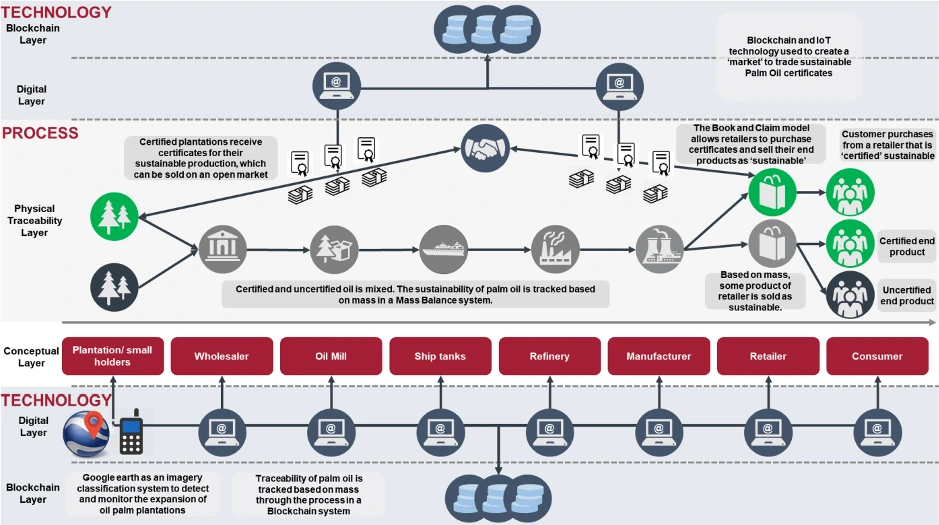
source: MIT Center for Transportation and logistics
BLOCKCHAIN ISSUES
Notwithstanding the vast number of projects that involve the blockchain use to support environmental issues, two big factors emerge that hint at a more controversial marriage between Blockchain and the environment.
Forbes magazine has interviewed Dr. Jonathan Foley, Executive Director, Project Drawdown who has declared without ambiguity that blockchain is not the answer to sustainability issues and for two very relevant reasons:
"First of all, blockchain systems — especially those used for Bitcoin and other so-called cryptocurrencies — are enormously energy-intensive. All those billions of calculations chew up computer power and electricity, often powered by coal and other fossil fuels," said Foley. "Altogether, blockchain and cryptocurrency computations use more electricity than the entire nation of Ireland and far less than all of Google."
"Second, the idea that energy-intensive blockchain systems are needed to ensure the world shifts to clean environmental practices — like sustainable land use, legitimate carbon offsets, and environmentally-friendly supply chains — is ridiculous," added Foley. "No one has ever said, 'Gosh, we could give the world sustainable forest products and food, environmentally-friendly materials, and a low-carbon energy system, but we can’t because our databases aren’t secure enough'. Computer records are not the thing keeping us from building a sustainable future."
"Even if we used blockchain for “secure" record-keeping on environmental practices, what’s to stop the original data record — about an acre of land cleared in the rainforest, an illegally harvested tree, or an unsustainable supply chain — from being a lie? Blockchain systems might be reasonably secure — although not any more than many good databases — they still suffer from the idea of 'garbage in, garbage out' -- if the original record is a lie, it’s still a lie," said Foley.
I have made some investigations and indeed these observations seem to be spot on.
According to other sources, the calculation power required by current blockchain algorithms, the most famous being Bitcoin, is enormous. It has been calculated that each time someone buys something using Bitcoin, the transaction requires an amount of energy larger than what is needed to power a typical home in America for a day. Each financial transaction performed using Bitcoin is estimated to be more than 5000 times more energy-intensive than a transaction made using a standard credit card.
So why use so much power for cryptocurrencies?
The answer lies in the miners (computers) who create new blocks by solving complicated algorithms. Miners are rewarded for their work with tokens and they compete with each other to mine blocks. The problem is that the more blocks they mine, the more complex the mining process is and the more energy is needed. In China, where coal-fired power plants produce electricity, there is a large volume of Bitcoin mining to make matters worse.
Blockchain transactions not involving cryptocurrencies should indeed have a lower energetic footprint, but there is still the big issue of how to assure that "smart contracts" objects are effectively linked to their blockchain records. When the blockchain leaves the immaterial world of the cyberspace to inter the real world made of real goods we add a weak link in the strong chain of crypto trust of the blockchain
In addition to this, Smart Contracts, embedded in a blockchain, are pretty stupid.
The "smart" part of the contract does not require the cooperation of the other party to carry out the contract. What makes smart contracts powerful is the automatic execution of the agreed consequences. In other words, making a contract trustless means that we really can't have any room for ambiguity, which brings up the next question A truly smart contract would take all the possible circumstances into consideration.
There are some significant consequences of complexity, a complex contract is also very difficult to secure and code. The more complex the agreement becomes, the harder it becomes to execute, even in normal contracts, as complications create more uncertainty and space for interpretation. Security means handling every way a contract can be executed with smart contracts and ensuring that the contract does what the authors intend to do.
And finally, even if we can solve the complex issue of coding a contract which determines all possible circumstances, smart contracts only work if there is a definite link between the digital version and the physical real world object. And this is probably the most powerful constraint.
That is, the physical version also has to change ownership whenever the digital version of the house changes ownership. The digital world needs to "know" about the physical world.
Therefore, transferring the blockchain from the cyberspace or merely financial transactions into the material world might severely limit its effectiveness.
What you really get is the difficulty of attempting to encode all possible outcomes with the subjectivity and uncertainty of human judgment instead of getting machine-only execution and streamlined compliance. In other words, in making a "smart" contract, you have made writing more difficult while still having to trust someone to execute it.
Conclusion
From the ideas and notes I have collected before, I believe that blockchain technology to be effective in helping more sustainable supply chains and become a mainstream tool commonly used in most industries and in particular the sustainability sensitive ones, has to change and evolve.
Some new technologies are already emerging to make blockchain more sustainable, replacing the calculation intensive activity of block mining with more efficient, “blockless” solutions (for instance one of these new emerging technologies is called DAG Directed Acyclic Graph, and just uses previous transactions to verify new ones).
This doesn’t mean, however, that blockchain can’t be used to gradually improve transparency and trust in industries where there are important environmental and ethical concerns like in the palm oil production.
From fraud protection and supply chain integrity, blockchain technology has numerous applications in procurement and procurement functions can benefit from the speed and efficiency of blockchain, and its immutability, but blockchain alone is not the silver bullet that will eliminate the environmental and ethical issues of supply chains, only the decision-making process guided by sustainability savvy and well trained and empowered procurement officials can make the actual difference.